

There is no one-size-fits-all template for sports venue construction.
The right solution depends on the client’s needs, venue function, site conditions, budget, and future use.
Different sports venue types require different architectural forms, spatial layouts, structural systems, and supporting facilities.
During the planning stage, project teams may confuse stadiums with indoor arenas or specialized venues with multipurpose facilities. This can lead to inefficient layouts, unused space, and unnecessary construction costs.
The LFBJMB team develops architectural and steel structure solutions based on specific project requirements.
This article introduces the main types of sports venues and explains how to select the appropriate type for a new project.
1.Main Architectural Types of Sports Venues
Sports venues can generally be divided into five main categories:
- Large outdoor stadiums
- Multipurpose indoor arenas
- Specialized swimming venues
- Tennis venues
- Multipurpose sports halls
Each type serves a different purpose.
The venue type affects the required space, spectator capacity, roof design, structural system, equipment layout, and operating requirements.
Selecting the right type at the beginning can help the project avoid unnecessary construction and improve long-term utilization.
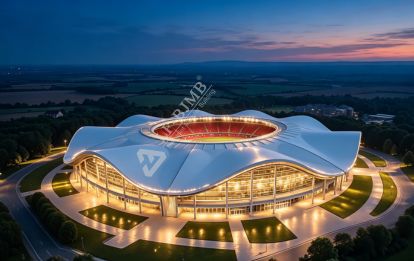
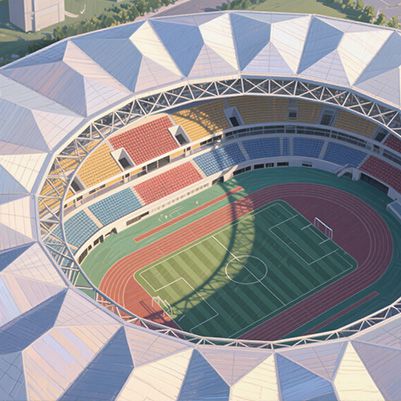
2.Football Stadiums / Large Stadiums (Outdoor Main Venues)
These venues primarily host outdoor ball games and track-and-field events; prime examples include dedicated football stadiums and comprehensive track-and-field stadiums.
They occupy large footprints and offer high seating capacities—often tens of thousands of seats—characterized by an open layout.
Roofing structures typically require ultra-long-span cantilevers; there is no need to enclose the entire interior, as the roof primarily covers the spectator stands. Cantilever spans often exceed 40–60 meters.
Functionally, they can host major competitions, performances, track-and-field meets, and football leagues, making them suitable for large-scale events with high crowd volumes.
Structurally, they utilize long-span cantilever systems, prioritizing wind resistance, drainage, and protection from sun and rain; requirements for airtightness and ceiling height are minimal, resulting in an open, airy space.
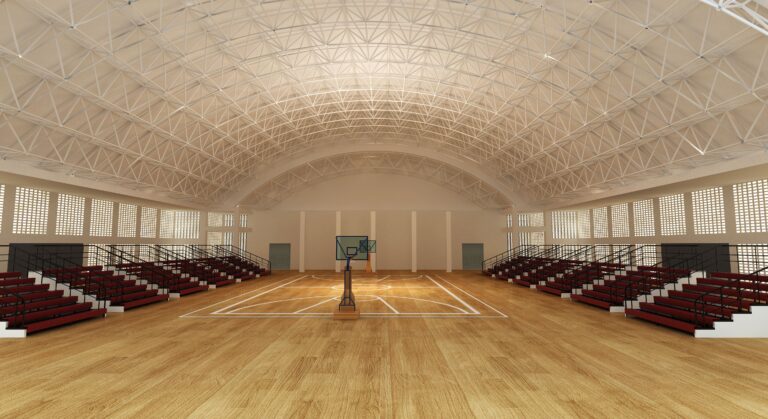
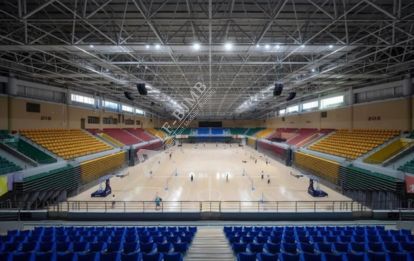
3.Basketball Arenas / Multi-purpose Indoor Arenas (Core Indoor Venues)
Multipurpose indoor arenas provide enclosed spaces for a wide range of sports and events.
Basketball often serves as the primary sport. The same venue may also host volleyball, badminton, gymnastics, competitions, performances, and other activities.
Unlike outdoor stadiums, indoor arenas require a controlled internal environment.
The design team needs to consider:
- Clear height
- Column-free space
- Indoor temperature
- Ventilation
- Acoustics
- Lighting
- Spectator visibility
- Equipment installation
Professional venues may require substantial clear height. The exact requirement depends on the sport, competition level, equipment, and applicable standards.
Structural Characteristics
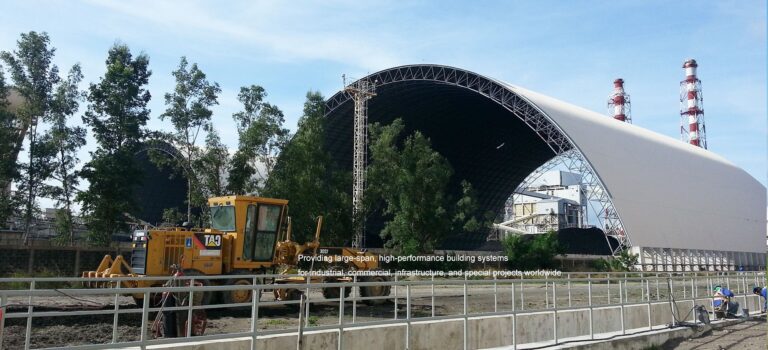
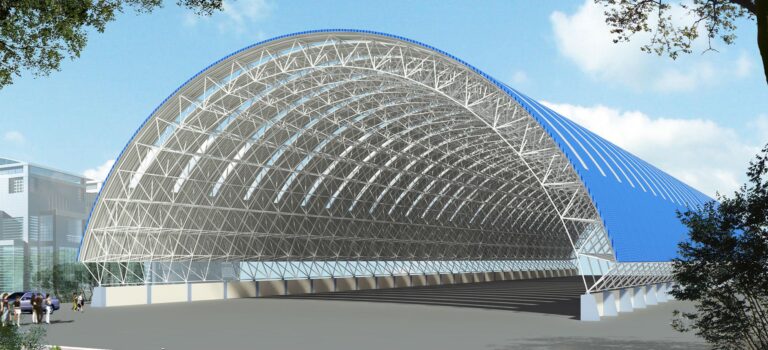
Large indoor arenas usually require a long-span roof structure.
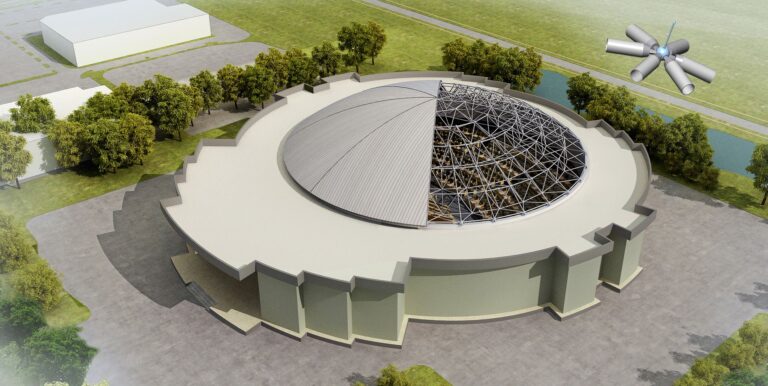
Space frames, tubular trusses, steel trusses, and other structural systems can provide large column-free spaces.
The appropriate system depends on the building span, roof form, loads, fabrication method, and construction conditions.
The structural system should also allow sufficient space for lighting, sound equipment, screens, HVAC systems, and other MEP facilities.
4.Specialized Swimming Venues
Swimming venues are highly specialized facilities, categorized into those for public recreation and those for professional competition.
Their most significant difference from other venues lies in their environment, characterized by high humidity, abundant water vapor, and strong corrosive elements.
While they do not require extreme structural spans, they demand high standards for corrosion resistance, moisture protection, ventilation, and thermal insulation.
Indoor environments experience constant high humidity (often exceeding 60–70% relative humidity), requiring specialized anti-corrosion and moisture-proofing measures for steel structures, building envelopes, and electromechanical systems.
Pool water must be kept at a constant temperature (typically 28–30°C), air requires active exchange, flooring must be slip-resistant, and lighting should be soft—prioritizing safety and comfort above all.
They are suitable for professional swimming competitions, daily training, and public fitness activities.
5.Tennis Venues
Tennis facilities can include outdoor courts, covered courts, and fully enclosed indoor facilities.
Tennis courts have standardized playing dimensions. This makes the basic court layout relatively predictable.
However, the surrounding building still requires careful planning.
Key Design Considerations
Important factors include:
- Court dimensions
- Clear height
- Lighting
- Wind protection
- Rain protection
- Spectator areas
- Player circulation
- Ventilation
Tennis facilities generally require less structural complexity than large stadiums.
Projects can use individual courts or group several courts into one facility.
This flexible layout makes tennis venues suitable for communities, schools, campuses, sports parks, and commercial sports centers.
6.Multi-purpose Sports Venues (Composite Sports Facilities)
Multipurpose sports halls support several activities within the same building.
A single facility may accommodate:
- Basketball
- Badminton
- Table tennis
- Fitness activities
- Training
- Community events
- Performances
- Exhibitions
The main advantage is flexibility.
Instead of designing the building around one sport, the project team can create adaptable spaces for different activities.
Structural Characteristics
Multipurpose sports halls generally use regular and practical structural layouts.
The required span depends on the activities inside the building.
The design may also include movable partitions, suspended equipment, retractable seating, and flexible lighting systems.
These requirements should be coordinated with the structural design from the beginning.
Multipurpose halls can suit schools, communities, townships, sports parks, and smaller sports centers.
7.Why do sports venues generally require large-span structures?
Sports venues differ from ordinary buildings in that their interiors cannot have columns obstructing sightlines.
Whether it is the competition arena, the athlete zone, or the spectator stands, the space must be complete, open, and unobstructed.
Ordinary buildings rely on numerous columns to distribute loads and are relatively easy to construct;
Sports venues must forgo internal columns, relying instead on large-span integrated structures to cover the entire area.
This is why space frames, trusses, and large-span rigid frames are commonly used—they ensure safety and compliance with competition standards while withstanding large crowds and spectator activity.
8.How do you choose the right architectural form based on the sport?
During the planning phase, there is no need to blindly pursue massive scale or high specifications; simply match the design to actual needs:
Large-scale events, football, and track & field — choose an open-air, large-span stadium;
Indoor multi-sport use and a mix of competitions and performances — choose a standard multi-purpose indoor arena;
Specialized swimming training and recreational water activities — choose a dedicated natatorium (swimming center);
Tennis and niche sports — choose lightweight, clustered court facilities;
Daily multi-functional use — choose a composite-type sports arena.
Matching the project to the right building type ensures functional needs are met while avoiding over-construction and controlling investment costs, leading to higher long-term utilization rates.
9.FAQ
Q: What is the main difference between a stadium and an indoor arena?
A: The main difference lies in spatial characteristics and usage. Stadiums are typically open-air facilities designed for large outdoor events like track and field or football;
Indoor arenas are fully enclosed spaces suitable for indoor ball games, fitness activities, and performances, requiring higher standards for the indoor environment, vertical clearance, and structural airtightness.
Q: Do all sports venues require ultra-large-span structures?
A: No. The span structure can be selected based on specific needs, balancing cost-effectiveness with practicality. If you have questions, please contact the LFBJMB team to help determine the best solution.
Q: How do I choose between a multi-purpose arena and a specialized sports venue?
A: For long-term, high-frequency use of a single sport, choose a specialized venue; it offers greater professional functionality and lower operation and maintenance costs;
If the facility needs to accommodate multiple sports, performances, and public services, prioritize a multi-purpose arena; it offers higher utilization rates and better value for money.
Conclusion
Selecting the right sports venue type is an important decision at the beginning of a construction project.
The project should start with its intended use rather than a predetermined building form.
Football stadiums, indoor arenas, swimming centers, tennis facilities, and multipurpose sports halls each have different spatial and technical requirements.
The structural system should follow these requirements.
Long-span structures can provide the open spaces required by many sports venues. However, the final solution should also consider local conditions, construction methods, equipment, investment, and long-term operation.
LFBJMB provides tailored architectural and steel structure solutions for sports venues based on project requirements, site conditions, span requirements, and intended use.
Need a sports venue solution for your project? Contact the LFBJMB team to discuss your requirements.