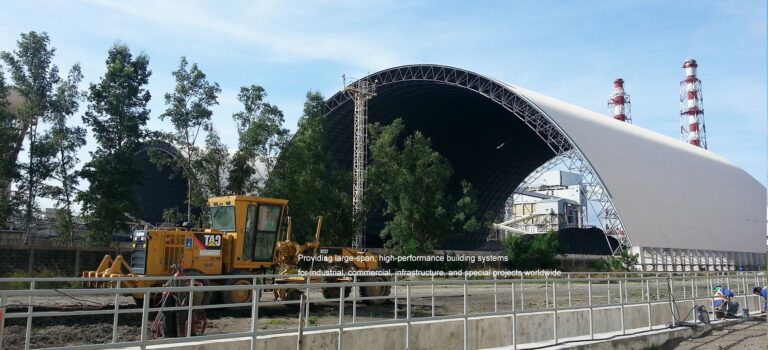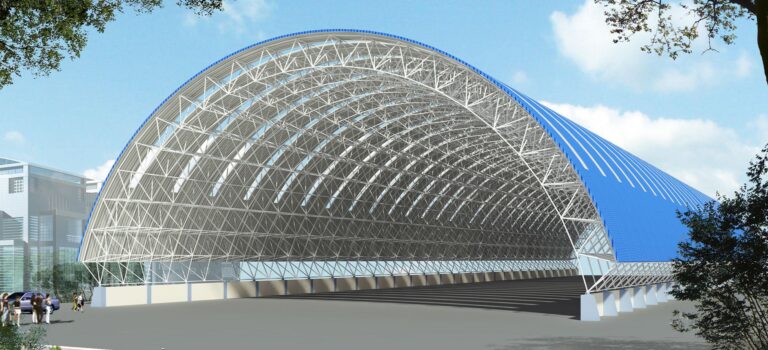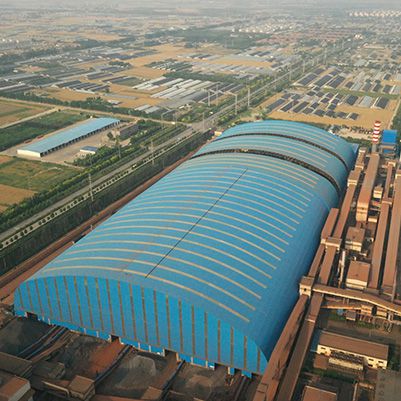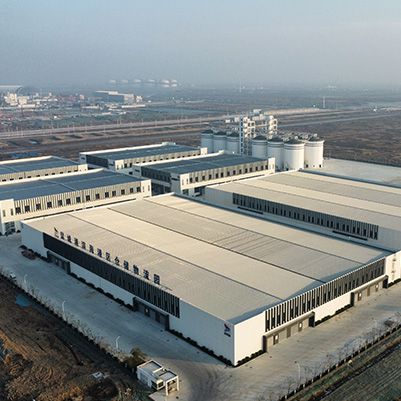
In long-span steel structures, such as glass domes for shopping malls, high-altitude welding can create significant construction challenges.
Workers must operate at elevated positions. Welding quality can be difficult to control, and skilled labor is often essential. Weather conditions may also affect construction schedules.
How can project teams reduce these risks?
The answer lies in prefabrication, connection optimization, and improved construction planning. By moving more fabrication and assembly work to the factory or ground level, contractors can improve installation efficiency and quality control.
This article introduces four practical steel structure construction methods that help reduce high-altitude welding and improve project execution.

Method 1
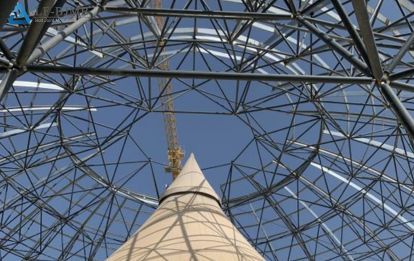
Use of Positioning Supports for Installation: This approach centers on the deployment of specialized temporary support frames, which provide a precise and stable platform for positioning structural components during the installation phase.
Function
The primary role of these positioning supports is to secure and calibrate the spatial orientation of components, ensuring they remain in their designed configuration prior to final connection. This eliminates the repetitive “measure-adjust-temporarily secure” cycle typical of high-altitude work, creating a stable environment directly for welding or bolting operations.
Advantages
Improved installation accuracy
Positioning supports help control component alignment and reduce dimensional deviations during assembly.
Better working conditions
Workers can focus on connection tasks instead of manually holding or adjusting heavy components.
More controlled installation
The method is particularly useful for heavy members, complex joints, and cantilevered sections.
Application Considerations
The temporary support system must be designed for the construction loads and the partially assembled structure.
Engineers should verify support locations, load transfer, and overall stability. The removal sequence must also be planned to prevent unexpected structural deformation.
Method 2
Application of Hybrid Bolted-Welded Connections: This method optimizes joint design by shifting the majority of welding work to a factory environment, leaving primarily bolted connections for the construction site.
Implementation
Connection plates are welded to the main structural members (such as chords) in the factory, creating standardized connection ends pre-drilled with bolt holes. During on-site installation, secondary members (such as web members) are fastened directly to these plates using high-strength bolts.
Advantages
More consistent welding quality
Factory welding provides better control over working conditions, welding procedures, and inspection.
Faster on-site installation
Bolted connections can reduce the time required for field welding, especially when working at height.
Improved installation flexibility
Properly designed connections can accommodate limited adjustments during installation.
Application Considerations
The connection design must clearly define the load transfer mechanism, bolt specifications, and installation requirements.
Slotted holes should only be used where the structural design permits them. Their use must not compromise the required connection strength or performance.
Not every welded connection can be replaced by a bolted connection. Engineers must evaluate the structural behavior and applicable design requirements before making changes.
Method 3
Fully bolted connections can eliminate field welding in suitable structural applications.
This method is particularly useful for secondary structures and short-span components that can be safely assembled using bolted joints.
Implementation
For secondary structures or short-span areas within a dome (such as maintenance walkways or decorative grids), joints are designed using high-strength bolts, with pre-welded connection plates (containing bolt holes) attached to the ends of the structural members.
Advantages
Simplified installation
The assembly process is easier to organize and can reduce the need for specialized welding operations at height.
Consistent connection quality
Properly designed and installed bolted connections provide reliable structural performance.
Easier future modification
Bolted connections may facilitate disassembly or replacement when the design allows for it.
Application Considerations
This method requires accurate fabrication and strict control of bolt-hole dimensions.
The design must also account for bolt strength, connection geometry, installation tolerances, and the required tightening procedure.
Although bolted connections can simplify installation, they may require additional connection plates or steel material. A complete structural and economic assessment is therefore necessary.
Method 4
Modular or unitized assembly with integrated lifting represents the highest level of prefabrication, shifting the majority of work from high-altitude environments to the ground or lower elevations.
Implementation
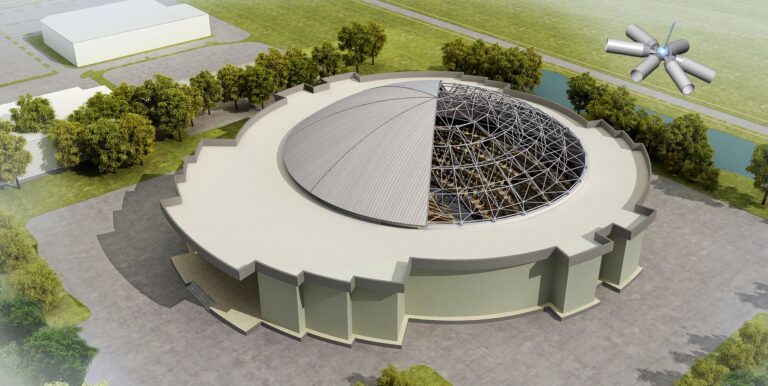
During the detailed design phase, the entire dome structure is divided into stable, rigid spatial units (modules). These modules are fully assembled—including welding and protective coating—either at a factory or on the ground at the project site. Large-scale lifting equipment is then used to hoist the modules to their design elevation, with final connections made only at the interfaces between the modules.
Advantages
Reduced high-altitude work
Ground-level assembly reduces the amount of welding, measurement, and coating work performed at height.
Improved construction efficiency
Fabrication and ground assembly can proceed alongside foundation and substructure work, where the project schedule permits.
Better quality control
Ground-level operations provide more convenient access for dimensional checks, welding inspections, and coating applications.
More predictable installation
Reducing the number of individual components installed at height can simplify construction planning.
Application Considerations
Modular assembly is most suitable for structures that can be divided into stable and manageable units.
Engineers must verify the temporary structural conditions during lifting and installation. The analysis should consider lifting points, module deformation, crane capacity, lifting radius, and site access.
The method also requires sufficient space for ground assembly and appropriate lifting equipment.
The four methods described above incorporate the use of “auxiliary support structures” and “joint optimization.” These solutions, which operate at different levels, are not mutually exclusive; they can be combined to develop a technical strategy best suited to a specific project.