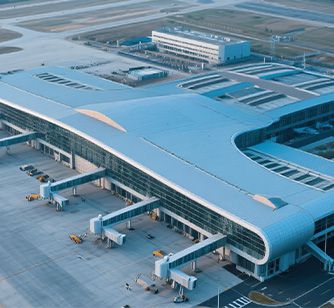


During the planning phase of an aircraft hangar project, dimensional parameters serve as the core basis for determining the structural design, construction costs, and functional requirements.
Unlike standard industrial buildings, aircraft hangars must accommodate specific aircraft dimensions and operational clearances. Therefore, floor area alone cannot determine the appropriate building size.
This guide explains the key parameters that project owners should define before design begins. It covers building span, length, clear height, aircraft dimensions, and operational requirements. With proper planning, owners can avoid insufficient clearance and unnecessary construction costs.
1. Why Can’t Aircraft Hangar Dimensions Be Calculated Simply Based on Floor Area?
Floor area provides a useful starting point. However, it does not show how efficiently a hangar can accommodate aircraft and support daily operations.
Two hangars with the same floor area may offer very different levels of functionality. Their span, clear height, door openings, and internal layouts can affect aircraft access and maneuverability.
Several factors determine the final dimensions:
- Aircraft dimensions: Wingspan, fuselage length, and tail height establish basic clearance requirements.
- Operational clearances: Aircraft towing, turning, positioning, and maintenance require additional space.
- Equipment requirements: Maintenance platforms, lifting equipment, and ground support equipment affect the internal layout.
- Hangar door dimensions: The openings must accommodate the intended aircraft and operating procedures.
- Future expansion: Additional aircraft bays or new operational requirements may increase space needs.
Therefore, project teams should define the aircraft and operational requirements before fixing the building dimensions.

2. Three Core Dimensional Parameters of Aircraft Hangars
2.1 Building Span
Span is the most critical control parameter for a hangar; it refers to the clear horizontal distance across the building without columns and directly determines whether an aircraft can safely park and undergo operations.
The span is primarily designed to accommodate the aircraft’s maximum wingspan, while also allowing for safety clearances on both sides and space for maintenance operations.
A large, column-free span enables aircraft to turn in place and facilitates multi-angle inspections; it is a core design criterion for civil aviation and large-scale maintenance hangars. The selection of the span directly determines the structural form, steel consumption, and overall construction cost.
2.2 Building Length
The length of an aircraft hangar determines its longitudinal operational capacity and primarily influences the number of parking bays and the layout of maintenance workstations. The length is calculated based on the aircraft’s overall length, safety clearances between parking bays, and front-to-back access corridors.
Reasonable length planning enables precise layout for single-aircraft bays as well as continuous arrangement of multiple bays, accommodating large-scale parking and batch maintenance operations.
2.3 Clear Height
The interior clear height of the hangar determines the aircraft’s vertical access and operational capabilities.
The height design must accommodate the maximum height of the aircraft’s tail section and include a safety margin, while also providing sufficient space for overhead lifting equipment and maintenance equipment operations, as well as allowing for the installation and layout of roof-mounted piping, lighting, and fire protection systems.
Insufficient clear height will directly prevent large aircraft from entering the hangar and make high-altitude maintenance operations impossible.
3. Design Characteristics of Hangar Dimensions for Different Aircraft Types
3.1 Small General Aviation Aircraft
With small fuselage dimensions, short wingspans, and low tail heights, these aircraft have lower requirements for span and headroom.
Hangars do not require an extremely large span; the structure primarily consists of economical portal frames with moderate spatial redundancy and low construction costs, making them suitable for small parking hangars.
3.2 Business Jets
These aircraft are of moderate size and have higher requirements for parking environments and spatial organization.
Designs must balance ease of access with a clean, orderly appearance. Span and headroom should be appropriately sized, with an emphasis on space utilization and airtightness to meet the demands of high-end parking and routine maintenance.
3.4 Large Transport Aircraft
These aircraft are large in size, have high load capacities, and require numerous operational equipment, necessitating extra-large spans, extra-high clear heights, and extra-long building dimensions.
Structural designs primarily consist of spatial space frames and tubular trusses, with the highest standards for spatial redundancy, equipment provisions, and safety margins.
4. Frequently Asked Questions (FAQ)
Q: Is a larger aircraft hangar always better?
A: Not necessarily. Hangar design requires a balance between functional requirements, operational flexibility, construction costs, and operational and maintenance costs.
A hangar that is too small may lack sufficient functionality and fail to accommodate operations; blindly increasing the size will lead to a sharp rise in steel consumption, higher construction costs, and increased daily energy consumption and operational and maintenance expenses. A customized design with reasonable built-in flexibility is the optimal solution.
5. Conclusion
The core parameters of aircraft hangar design center on three key dimensions: span, length, and headroom. These must be comprehensively determined in conjunction with aircraft model dimensions, operational requirements, equipment configuration, and future planning—and cannot be determined simply by calculating floor area.
Precisely defining design parameters ensures not only the hangar’s full functionality and operational efficiency but also avoids unnecessary investment, thereby achieving the project’s goals of safety, practicality, and cost-effectiveness.