

Located in the northwestern Pacific typhoon belt, the Philippines experiences frequent typhoons and high wind speeds throughout the year.
The country also has a hot, humid, and salt-laden coastal environment. These conditions create two major challenges for coal storage silo projects: extreme wind loads and long-term corrosion protection.
Large-span coal storage silos must maintain structural stability during severe typhoons. They must also resist corrosion over many years of operation.
For this reason, overseas clients often focus on how large-span coal storage silos in the Philippines maintain structural integrity after repeated typhoon events.
1.Core Challenges Faced by the Philippines Project
First, the climate of the Philippine islands creates several challenges for coal storage silo design.
Extreme Wind Conditions
The first challenge is the high wind speed associated with tropical cyclones. Depending on the project location and applicable design criteria, design wind speeds can reach 200 kph to 250 kph.
Severe typhoons can produce several types of wind effects. These include horizontal wind pressure, negative roof suction, and repeated wind-induced vibration.
These loads place high demands on the stiffness and stability of large-span structures.
High Humidity and Salt Fog
In addition, the coastal environment creates another major challenge.
High temperatures, high humidity, and salt fog can accelerate steel corrosion. Sea breezes carry salt particles that can accumulate on steel surfaces.
Without proper corrosion protection, the coating may peel or deteriorate. Corrosion can then affect structural members and connection components.
Over time, this deterioration may reduce structural durability and increase maintenance requirements.
Repeated Typhoon Loading
Finally, the repeated nature of typhoon events creates another challenge.
A project may experience strong wind and gust impacts many times during its service life. Repeated loading can increase the risk of connection loosening, structural fatigue, and displacement of roof or wall panels.
Therefore, conventional inland design approaches may not provide sufficient protection for projects in typhoon-prone coastal regions.
2.Design Measures for Typhoon Resistance in Philippine Coal Storage Silos
To address these challenges, Philippine coal storage silo projects require a systematic design approach.
2.1 Specialized Wind Load Verification
First, engineers should establish the wind load according to local project conditions.
First, the project team should verify the design using local meteorological wind speed data and the applicable design criteria.
For this project, the maximum design wind speed reached 250 kph.
The design team also carried out seismic calculations based on Seismic Zone 4 (Z=0.4). Engineers checked both wind and seismic loads to provide an appropriate structural safety margin.
2.2 Large-Span Spatial Truss Structure
Second, the project uses an integrated spatial truss system.
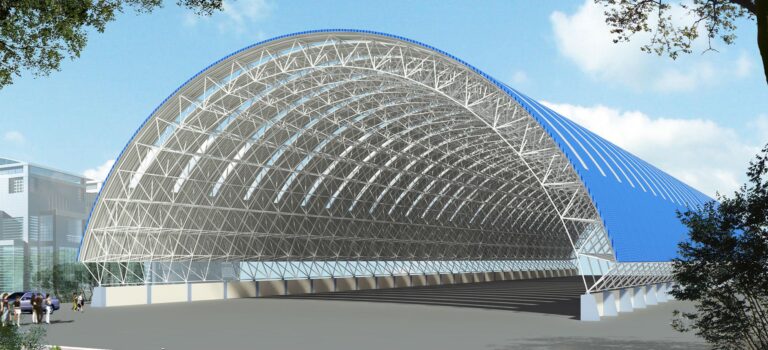
The design includes both a large-span dome truss system and a barrel-vault truss system.
The streamlined structural form helps guide airflow and distribute wind pressure. It can also reduce concentrated wind effects on the roof.
At the same time, the spatial truss distributes structural loads across the system. This approach provides the large-span, column-free space required for coal storage.
2.3 Reinforcement of Critical Connections
Third, engineers pay special attention to critical connections.
These areas include supports, member splices, and bolted connections.
The design uses high-strength connection hardware and optimized joint stiffness. These measures help reduce the risks of bolt loosening, connection slippage, and excessive deformation under repeated wind vibration.
Protecting these critical connection points is essential for maintaining the stability of the overall structure.
2.4 Wind-Resistant Roof and Wall Systems
Fourth, the project optimizes the roof and wall envelope systems.
The design uses weather-resistant color-coated steel roof panels. Engineers also increase the fastening density and use tighter fastening specifications where necessary.
Edge sealing and waterproofing details provide additional protection.
These measures help prevent strong winds from lifting roof panels. They also reduce the risk of water penetration during heavy rain and typhoon events.
2.5 Heavy-Duty Corrosion Protection
Fifth, the project uses an anti-corrosion system suitable for island and coastal environments.
The main structural members use Q355B high-strength steel. Depending on project requirements, the steel receives either:
- Hot-dip galvanizing plus a protective topcoat
- Zinc-rich epoxy primer plus polyurethane topcoat
These systems help protect the steel from salt spray and atmospheric corrosion.
Effective corrosion protection also helps preserve the long-term strength and durability of the structure. As a result, it supports the long-term wind resistance of the warehouse.
3.LFbjmb’s Typical Coal Storage Silo Project in the Philippines
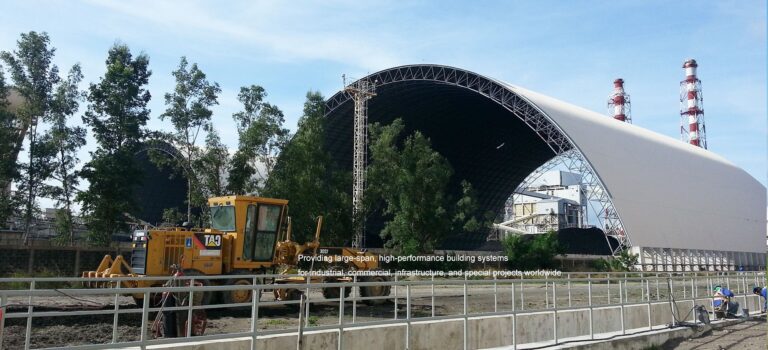
LF has completed large-span coal storage silo projects in the Philippines. The following projects demonstrate different structural systems and design requirements.
Project 1: Semirara Large-Span Roof Truss Coal Storage Silo
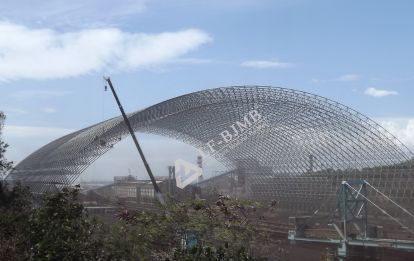
Project: Semirara Large-Span Roof Truss Coal Storage Silo, Philippines
Structural Type: Light-gauge steel spatial structure coal storage shed
Design Standards: ASCE standards
Clear Span: 124 m
Building Height: 39.977 m
Design Wind Speed: 225 kph
Seismic Zone: Zone 4 (Z=0.4)
Main Steel: Q355B
Corrosion Protection: Hot-dip galvanizing + protective topcoat
Roofing System: Color-coated profiled steel roofing panels
Certifications: ISO, CE, SGS
Delivery and Installation
LF completed component production and shipment within 30 working days after signing and drawing confirmation.
LF also dispatched technical personnel to provide installation guidance on site.
For transportation, large steel components used specialized cradles. Workers packed small parts and accessories separately in wooden export crates.
Design Service Life: 50 years
Project Performance
The project uses high-grade wind resistance and corrosion protection measures.
According to the project information, the structure has withstood multiple strong typhoons in the region. The main structure has remained stable without significant deformation.
The project has also maintained stable connections and roof and wall enclosure performance.
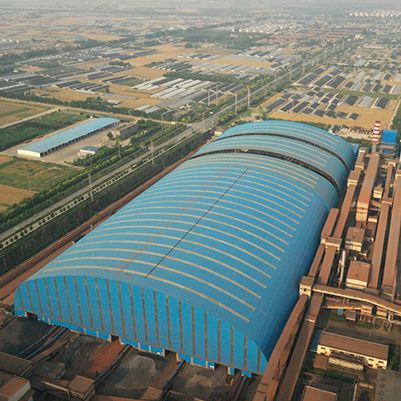
Project 2: Barrel-Shaped Space Truss Coal Storage Silo at the Toledo Power Plant, Philippines
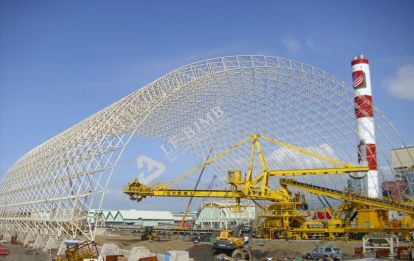
Project Name: Coal Storage Silo for the Coal Handling and Storage System at Toledo Power Plant, Philippines
Project Owner: Cebu Energy Development Corporation
Stored Material: Raw coal
Conveyor Belt Width: 800 mm / 1,200 mm
Conveying Capacity: 300 t/h / 900 t/h
Structural Type: Light-gauge steel spatial truss barrel-shaped coal storage silo
Design Standards: Chinese National Standards (GB)
Clear Span: 88 m
Building Height: 32.57 m
Design Coal Storage Capacity: 50,000 metric tons
Design Wind Speed: 200 kph
Seismic Zone: Zone 4 (Z=0.4)
Main Steel: Q355B
Corrosion Protection: Hot-dip galvanizing + protective topcoat
Roof: SMP weather-resistant color-coated steel roof panels
Skylights: FRP skylight panels
Certifications: ISO, CE, SGS
Production and Shipping: Shipment completed within 45 days after receipt of advance payment
On-Site Service: Engineers stationed on site to supervise installation
Design Service Life: 50 years
Project Performance
Since commissioning, the facility has operated through multiple typhoon seasons.
The overall structure has remained stable. The project has reported no major issues such as component bending, loose bolts, or roof panel cracking.
The coal storage, environmental protection, and wind resistance systems have maintained their expected performance during long-term operation.
4.Overall Performance of Philippine Projects
The Philippine coal storage silo projects use a comprehensive typhoon-resistant design strategy.
The design combines specialized wind load verification, spatial structural systems, reinforced connections, optimized roof and wall systems, and heavy-duty corrosion protection.
These measures work together to improve structural stability in severe weather.
The project structures have experienced multiple strong typhoons over the years. The available project performance data indicates stable overall structural conditions.
The main structural members show no significant visible deformation. Connection joints have maintained their stability, and the roof and wall cladding have remained in good condition.
The projects have also maintained the expected performance in areas such as structural stability, dust-proof sealing, corrosion resistance, and long-term durability.
Conclusion
The ability of Philippine coal storage silos to withstand repeated severe typhoons does not come from a single structural feature.
Instead, it results from a systematic design strategy.
More specifically, the strategy begins with specialized wind load verification. In addition, it combines an appropriate spatial structure, reinforced critical connections, optimized enclosure systems, and heavy-duty corrosion protection.
The design also considers local seismic requirements and actual site conditions.
LF’s Philippine projects demonstrate how these measures can work together in large-span coal storage applications.
For new power plant coal storage silos, enclosed bulk material storage facilities, port projects, and overseas retrofit projects, this approach can help balance typhoon resistance, corrosion protection, durability, safety, and cost-effectiveness.
Frequently Asked Questions (FAQ)
Q1: For coal storage silos exported to the Philippines, which standard takes precedence—ASCE or China’s GB standard?
A: The approach can be flexibly adapted to project requirements. The Semirara project adopted the locally recognized ASCE code to meet local design review requirements, while the Toledo and Putingbato projects adopted the Chinese GB standard, with performance parameters aligned with local wind and seismic criteria. Both approaches fully satisfy local building permit and safety requirements in the Philippines.