

For airport investors, aviation companies and project owners, investment in hangar construction is the key focus during the project approval stage.
Most owners will initially enquire: how much does it cost to build an aircraft hangar, and can the cost be estimated based on a unit price per square metre?
However, aircraft hangars are highly customised specialised aviation structures, and standard unit prices for ordinary industrial buildings cannot be applied.
This article provides a detailed analysis of the cost structure of aircraft hangars, the key influencing factors and the scientific logic behind pricing, to help investors quickly establish an accurate understanding of costs and avoid budgetary discrepancies and cost overruns.
1. Why can’t aircraft hangars be quoted simply based on floor area?
Ordinary steel-frame industrial buildings have uniform structures, small spans and simple ancillary facilities, allowing construction costs to be quickly estimated using a unit price per square metre.
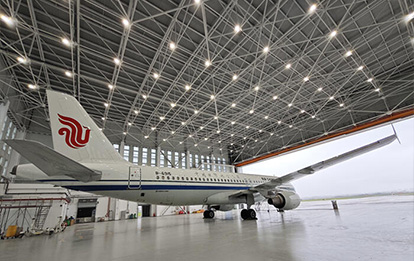
Aircraft hangars, however, are specialised aviation structures characterised by large spans, high clear heights, stringent safety standards and a high degree of customisation; consequently, construction costs can vary significantly between projects of the same floor area.
The final investment in a hangar does not depend on area alone, but is determined by the combined set of project conditions. Key variables include:
1) The type of aircraft to be accommodated (general aviation, business jets, narrow-body passenger aircraft, wide-body passenger aircraft, transport aircraft);
2) Building span and requirements for column-free space;
3) Hangar clear height and tail section clearance standards;
4) Selection of steel structure systems (gantry frames, tubular trusses, spatial truss structures);
5) Configuration of large specialised hangar door systems;
6) Aviation-grade fire safety, ventilation and M&E safety standards;
7) Construction conditions and climatic load standards in the country or region where the project is located.
Consequently, there is no standard market price for aircraft hangars; costs must be calculated on a bespoke basis according to project requirements.
2. What are the main components of aircraft hangar construction costs?
2.1 Design Costs
Hangar design is the starting point for project cost control; the design complexity of large-span aviation structures is far greater than that of ordinary buildings.
Design costs encompass a full suite of technical services, including architectural planning, structural analysis of large-span steel structures, wind, snow and seismic load analysis, specialised fire safety design, coordination of mechanical and electrical systems, and specialised integration of hangar doors.
High-quality preliminary design can effectively optimise the amount of structural steel used, avoid rework at a later stage and reduce the overall investment.
2.2 Main Steel Structure Costs
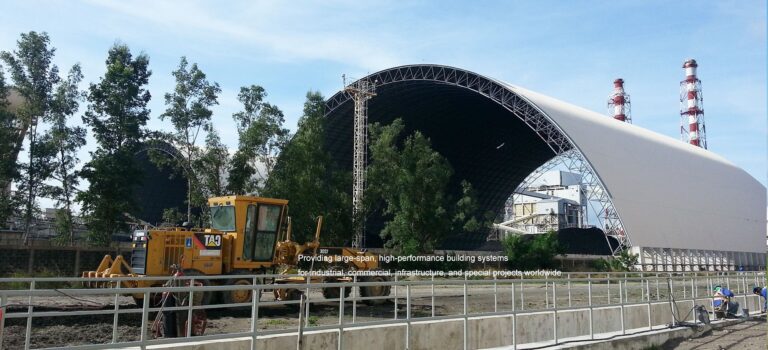
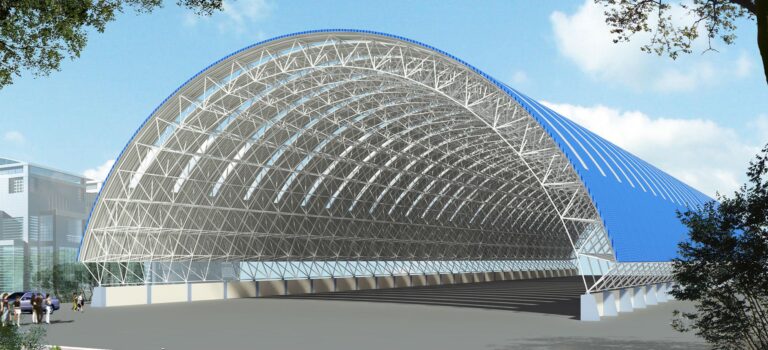
The steel structure is the core component accounting for the largest proportion of the hangar’s construction cost.
Costs are directly influenced by the building’s span, clear height, number of aircraft bays and structural system type.
Large-span, column-free hangars require structural designs with higher stiffness and greater stability; this significantly increases steel consumption, joint complexity and fabrication difficulty, making it a key factor in determining project costs.
2.3 Envelope System Costs
The envelope system encompasses the entire range of components, including the roof system, wall systems, thermal insulation, waterproofing and sealing, and corrosion protection.
As aircraft hangars must withstand extreme outdoor temperature fluctuations, wind and rain, and corrosive environments over the long term, the standards for their envelopes, corrosion protection levels and thermal insulation performance far exceed those of ordinary industrial buildings, directly impacting the building’s service life and subsequent operational and maintenance costs.
2.4 Hangar Door System Costs
Large hangar doors are a signature, high-cost feature that distinguishes aircraft hangars from ordinary steel structures.
The structural dead weight, wind resistance standards, sealing systems and precision requirements for electrical control systems of extra-large-span sliding, folding and sectional doors are extremely high. The cost of a single set of hangar doors is far higher than that of ordinary industrial doors, making them a significant and indispensable component of the hangar budget.
2.5 Transport and On-site Installation Costs
For domestic projects, costs primarily comprise the transport of components, hoisting, labour and equipment hire;
The cost structure for overseas projects is more complex, requiring the addition of expenses such as ocean freight, port handling, customs clearance, cross-border logistics, localised construction, translation and coordination, and overseas equipment hire, resulting in a significantly higher proportion of the total budget being allocated to transport and installation costs.
3.Key Factors Influencing Aircraft Hangar Investment
Different variables impact construction costs to varying degrees; the core logic is as follows:
3.1 Aircraft Model (Determines Basic Dimensional Standards)
There are vast differences in wingspan, height, and fuselage dimensions among general aviation light aircraft, business jets, commercial airliners, and large transport aircraft. These factors directly determine the hangar’s minimum span, clear height, and hangar door specifications, serving as the primary factor for cost classification.
3.2 Number of Bays (Determines Construction Scale)
Whether a hangar accommodates a single aircraft, two aircraft, or multiple aircraft in a connected layout, the building area, total structural length, and scale of supporting facilities increase accordingly, directly determining the overall investment volume.
3.3 Span and Height (Determines Structural Complexity)
Greater spans and higher clearances result in more complex structural loading dynamics. Steel consumption, the complexity of structural connections, and the difficulty of hoisting operations all increase simultaneously; these are the primary reasons why large hangars incur higher construction costs.
3.4 Safety and Operational Standards (Determines Configuration Level)
Standards for fire protection, ventilation, electromechanical systems, lighting, and safety redundancy differ significantly between storage hangars and maintenance hangars; maintenance hangars require higher-level configurations and entail greater investment.
3.5 Regional Environmental Conditions (Determines Design Specifications)
Locations subject to strong winds, heavy snow, high temperatures, coastal corrosion, or extreme cold require upgraded design standards for structural loads, corrosion resistance, thermal insulation, and wind resistance, all of which indirectly increase construction costs.
4.How to Conduct a Rapid and Accurate Hangar Cost Assessment?
To obtain an accurate quote and avoid inflated or underestimated budgets, the project team must provide the design and engineering teams with complete baseline information at the initial stage, including:
Specific aircraft models to be serviced,
Planned number of bays,
Hangar function (storage vs. maintenance),
Planned building dimensions,
Project location (country and city),
Local climate and structural load conditions.
Based on these conditions, a professional team can customize structural, hangar door, building envelope, and supporting facility plans. This enables precise cost estimation and design optimization, ensuring investment costs are controlled while meeting all safety standards. 5. Conclusion
There is no standard market price for aircraft hangar construction; costs are primarily determined by a combination of factors, including aircraft specifications, span and height dimensions, structural systems, hangar door configurations, safety standards, and site-specific conditions.
Accurately defining requirements and developing a scientifically tailored plan during the project’s preliminary stage are crucial for controlling investment, avoiding budget overruns, and maximizing cost-effectiveness.
Professional preliminary cost assessments enable investors to precisely manage project budgets and achieve the construction of modern hangars that are safe, compliant, and cost-efficient.
FAQ
Q: Can aircraft hangar projects be quoted based on a standard price per square meter?
A: No. Aircraft hangars are highly customized aviation facilities. Factors such as aircraft dimensions, span and height, structural type, fire safety ratings, and door configurations vary significantly; construction costs for the same floor area can differ by as much as 100%, making it impossible to apply a fixed unit price per square meter.
Q: Are large aircraft hangars necessarily much more expensive to build than small ones?
A: While the total investment is higher, the unit cost can be effectively reduced through scientific structural optimization, appropriate design choices, and spatial integration. By avoiding over-engineering, it is possible to achieve cost-effective construction for large-span hangars.