

During the design phase of coal storage silos, many project owners mistakenly believe that a larger span equates to higher site utilization and better project outcomes, leading them to blindly pursue designs with ultra-large spans. However, in practical engineering applications, a larger span is not necessarily better; while ultra-large spans offer spatial advantages, they also entail increased costs and greater design complexity. Selecting an appropriate span requires a comprehensive assessment of factors such as storage capacity, site conditions, equipment configuration, and the investment budget to ensure the design is suitable, safe, compliant, and economically optimal.
Core advantages of large-span coal storage silos
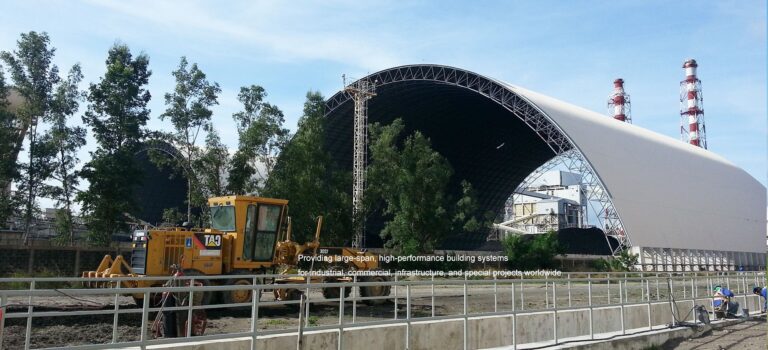
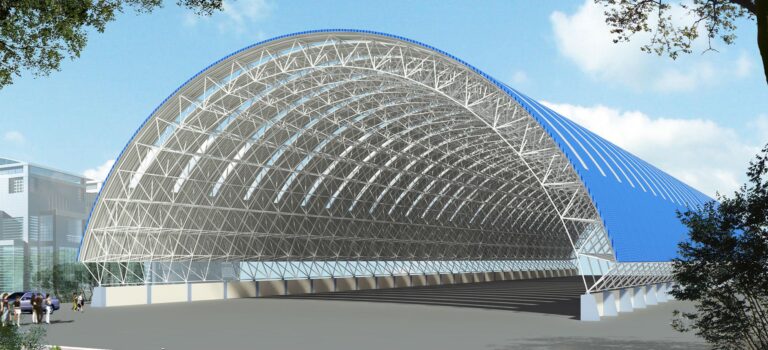
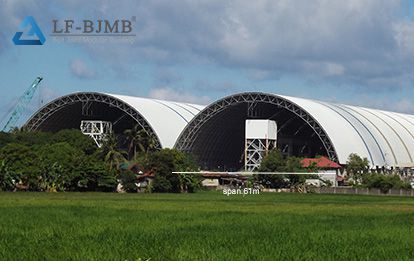
A well-designed large span significantly enhances the functionality and operational efficiency of the coal storage silo. Large-span structures allow for an open interior layout free of intermediate columns, creating a spacious and unobstructed storage area without “dead zones” caused by pillars. This maximizes the effective storage footprint, enabling greater capacity within the same site area. Furthermore, the open interior accommodates the free movement of large-scale automated equipment—such as stacker-reclaimers and loaders—allowing for smooth operational paths without the need to maneuver around columns. This greatly boosts mechanization efficiency, reduces the need for manual intervention, and meets the demands of continuous, large-scale production operations at major coal yards.
Drawbacks and challenges of blindly pursuing ultra-large spans
Blindly increasing the span without regard for actual project needs can lead to multiple negative consequences, where the costs outweigh the benefits. As the span increases, the overall structural load rises significantly, requiring a much larger quantity of steel; this directly drives up initial construction investment and diminishes economic viability. Additionally, the structural systems for ultra-large spans are far more complex, demanding rigorous structural analysis, joint optimization, and high-precision load matching, making the design process much more challenging than that of standard-span silos. During construction, the hoisting, assembly, and precision control of ultra-large components are significantly more difficult. This places higher demands on the construction team’s technical expertise, equipment capabilities, and site management standards, while also extending the construction schedule and increasing project risks.
Selection Criteria for Optimal Spans Based on Project Scale
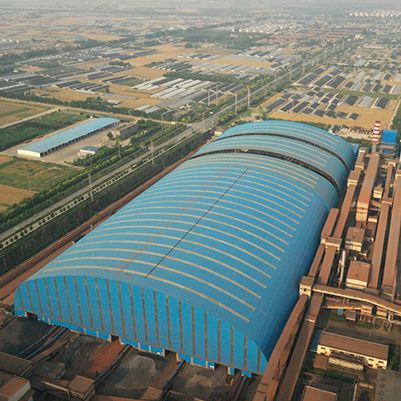
Selecting the span for a coal storage facility requires adhering to principles of matching specific needs and tiered suitability; the most reasonable span range is chosen based on project scale, storage capacity, and operational requirements, balancing practicality with cost-effectiveness. Small-scale coal storage projects—characterized by limited storage volume and simple equipment operations—are well-suited to spans of 30 to 50 meters; these structures are simple, economical, and quick to build, fully meeting daily storage needs. Conventional industrial coal storage projects (such as those for thermal power, steel, and cement plants) typically utilize the mainstream span range of 50 to 80 meters; this range offers mature structural designs, high cost-performance ratios, and compatibility with the vast majority of mechanized operational scenarios, making it the most widely used specification in the industry. For massive projects—such as large-scale coal storage bases, centralized port stockpiles, and national-level energy storage and transport facilities—designs with large spans of 80 to 120 meters can be employed. These leverage the advantages of column-free, expansive spaces to accommodate high-volume, high-turnover, and highly automated storage operations.
Conclusion
A larger span for a coal storage facility does not necessarily equate to a superior design; the core of engineering selection lies in finding the right fit. While large-span coal sheds offer advantages such as ample space, operational efficiency, and greater storage capacity, they also entail drawbacks like higher material consumption, increased design and construction complexity, and higher costs. Selecting the appropriate span based on project scale allows for a perfect balance between structural safety, operational effectiveness, and construction economy, thereby maximizing the project’s overall benefits. Contact us to obtain the optimal architectural solution.
Frequently Asked Questions (FAQ)
Q1: Is a larger span always better for a coal storage facility?
A: Not necessarily. The span must be determined by comprehensively considering coal storage requirements, equipment configuration, site conditions, and the investment budget. Blindly increasing the span only raises construction costs and complexity without enhancing the project’s overall value.
Q2: Which projects are best suited for large-span coal storage facilities?
A: They are primarily suited for key projects requiring large storage capacities, high levels of automation, and expansive, unobstructed operational spaces—such as large industrial coal yards, port coal storage bases, and large-scale bulk material storage centers.
Q3: Do conventional factory coal yards require ultra-large spans?
A: No, they do not. For standard coal storage yards at conventional power plants, steel mills, and cement plants, a standard span is the optimal choice; it offers the best cost-performance ratio, utilizes the most mature technology, and ensures the most hassle-free operation and maintenance.