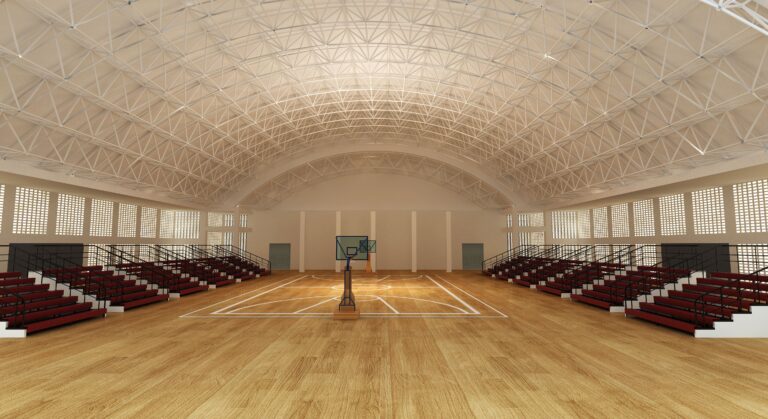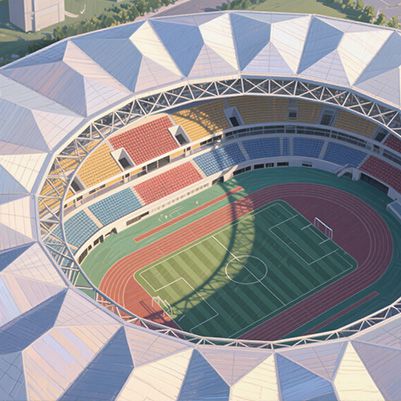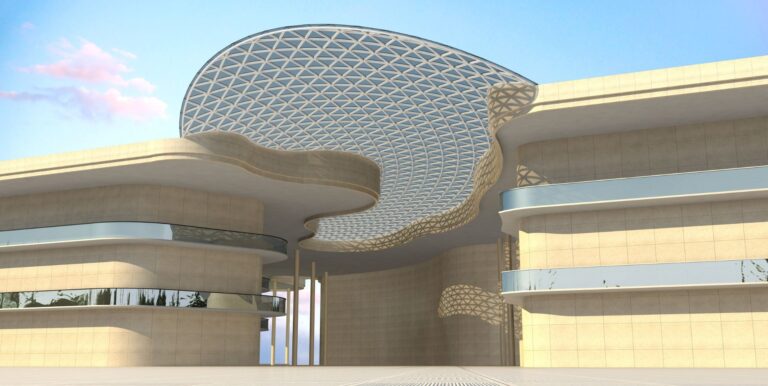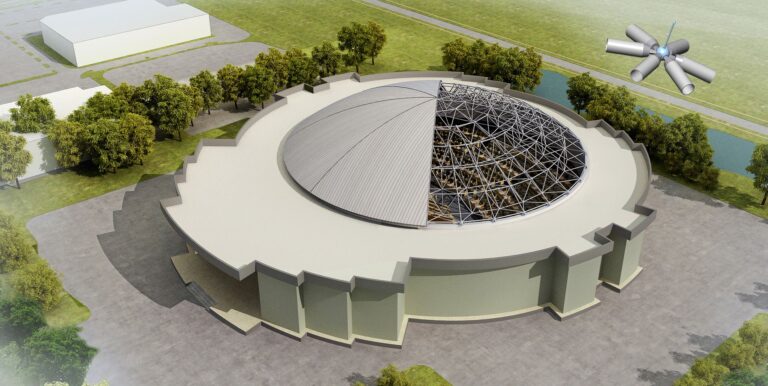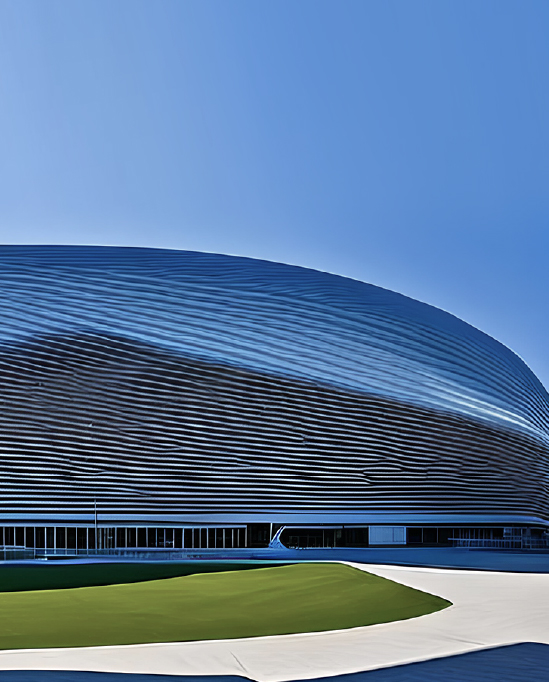


The inspection and evaluation of large-span bolted spherical structures is a complex and professional task. Its core lies in assessing the safety, applicability, and durability of this spatial load-bearing system.
The steel structure is the main load-bearing structure, and its failure has more serious consequences. The following are the key points and contents of the inspection and evaluation.
1.Key Points of On-site Inspection and Investigation
This is the foundation of the evaluation work and must follow the principle of “from the whole to the part, from the macro to the micro.”
(1) Overall Condition and Deformation Observation
Overall Deformation (Deflection):
Measure the vertical deflection at key points such as the mid-span and quarter-span of the steel structure and compare it with the design value and the allowable value specified in the code.
Excessive deflection is an important indicator of insufficient load-bearing capacity or support problems.
Member Bending and Deformation:
Inspect the members for out-of-plane bending, local bending, and twisting. This is a direct manifestation of member instability or overload.
Drainage Condition:
Check whether the roof panels, gutters, and drainage outlets are unobstructed and whether there are areas with long-term water accumulation.
Water accumulation will greatly increase the additional load and accelerate corrosion.
(2) Material and Coating Deterioration Detection
Steel corrosion is the most common and dangerous problem. Key areas to check include:
Damp heat condensation areas:
Below areas where the roof insulation vapor barrier is damaged, near gutters, and in poorly ventilated corners.
Coating damage areas:
The extent of substrate corrosion at areas where the coating is blistering, peeling, or powdering.
Section loss assessment:
Measure the wall thickness or diameter loss rate of the most severely corroded members and bolt ball joints. This is crucial data for load-bearing capacity verification.
Fireproof and anti-corrosion coatings:
Check if the coating is intact and effective, and whether there is large-area peeling or cracking.
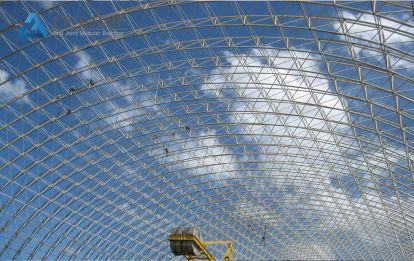
(3) Joint Inspection (Top Priority)
Joints are the “joints” of the steel structure, and their safety is paramount.
Bolt ball joints:
Spherical Parts: Check for cracks, excessively deep rust pits, and damaged threaded holes.
High-strength Bolts: Check for looseness, breakage, thread corrosion, and bent bolts. A special wrench can be used to check the tightness of the bolts.
Sleeves, Conical Heads/End Plates: Inspect for cracks, excessive deformation, and the integrity of welds to the members.
Member End Connections: Observe the connection area between the member end and the conical head/end plate for slippage or scratches caused by loose bolts.
Welded Ball Joints:
Spheres: Inspect the surface for cracks, especially near the butt welds.
Welds: Focus on inspecting the quality of the circumferential weld connecting the sphere and the member for cracks, incomplete penetration, undercut, porosity, and other defects. Perform non-destructive testing (e.g., magnetic particle or ultrasonic testing) if necessary.
Support Joints:
Support Type: Confirm whether it is a fixed hinge support, sliding support, or resilient support.
Displacement and Deformation: Inspect the support for abnormal slippage, voids, settlement, or tilting.
Connection Status: Inspect the support anchors for looseness or breakage, and the support plate for deformation or corrosion.
Limiting Devices: For sliding supports, check if the sliding is within the design range and if the limiting blocks are effective.
(4) Connection and Construction Inspection
Staff Connections: Ensure all staff are connected in place as designed, with no missing or unauthorized staff replacements.
Support System: Check the integrity and effectiveness of horizontal supports, vertical supports, tie rods, etc., for any missing, loose, or deformed components. This is crucial for ensuring the structural spatial stability.
Connection to Enclosure Structure: Check the reliability of the connections between roof panels, purlins, suspended loads (such as lighting fixtures, ductwork), and the space frame to avoid chain reactions caused by localized damage.
(5) Environmental and Load History Investigation
Load Changes: Investigate whether permanent loads (such as the addition of equipment floors, suspended ceilings, heavy lighting fixtures) or live loads (changes in function) have been added during use.
Disaster History: Has the structure experienced wind loads exceeding design limits, heavy snow, earthquakes, accidental impacts, etc.?
Environmental History: Are there any harsh environments such as corrosive gases, high temperatures, or high humidity?
2.Key Points of Analysis and Evaluation
Based on on-site testing and data collection, calculation analysis and comprehensive evaluation are conducted.
(1) Structural Analysis, Modeling, and Verification
Establish a calculation model: Based on the measured structural geometric dimensions, member cross-sections (considering corrosion loss), node connection assumptions, and support constraints, establish an accurate calculation model.
Load Verification: According to current specifications and usage conditions, redetermine dead loads, live loads, wind loads, snow loads, temperature effects, etc.
Bearing Capacity and Stability Verification:
Member Strength and Stability: Verify the strength, slenderness ratio, and stability of each member under the most unfavorable load combination. Corroded members need to be verified based on the remaining effective cross-section.
Node Bearing Capacity: Verify the bolt tensile strength and sphere tensile and compressive strength of bolted ball joints; verify the weld strength of welded ball joints.
Overall Stability: Perform eigenvalue buckling analysis to evaluate the overall stability safety factor of the space frame.
Deformation Verification: Verify whether the space frame deflection meets the specification requirements.
(2) Defect Impact and Safety Assessment
Sensitivity Analysis: Analyze the risk of progressive collapse caused by the failure of critical members (such as the mid-span lower chord and support web members) or node damage.
Fatigue Assessment (if applicable): For steel structures subjected to frequent vibration loads (such as equipment vibration and crane operation), assess the fatigue damage of nodes and members.
Risk Level Determination: Based on the severity of defects and calculation results, classify the safety of the structure and identify critical areas requiring immediate attention.
(3) Comprehensive Reliability Rating and Treatment Recommendations
Based on the “Industrial Building Reliability Appraisal Standard” (GB 50144) or the “Civil Building Reliability Appraisal Standard” (GB 50292), conduct a comprehensive rating of the steel structure (e.g., A/B/C/D level) and provide targeted recommendations:
Routine Maintenance: Treat minor defects with anti-corrosion measures and tighten them.
Reinforcement Treatment: For members with insufficient load-bearing capacity, reinforce them with steel plates, carbon fiber cloth, or add sleeves; for problematic nodes, replace bolts, repair welding, or add node plates for reinforcement.
Support Repositioning and Repair: For supports with excessive settlement or slippage, jack them up, reinforce them, or replace them.
Partial or Overall Replacement: For structures with large-area severe corrosion, insufficient overall safety reserve, or a risk of collapse, partial or overall replacement should be considered.
Summary
The core of the inspection and evaluation of large-span spherical space frames can be summarized as: “From macro to micro, from members to nodes, from deformation to corrosion.”
Three Core Components: Members (strength and stability), Nodes (bolted ball/welded ball), Supports (constraint and displacement).
Two Key Defects: Steel corrosion (leading to cross-sectional loss) and loose/failed connections (altering the stress system).
One Core Analysis: Refined modeling and load-bearing capacity verification based on measured data.
Ultimate goal: To identify the weak points in this highly statically indeterminate spatial structure, assess its overall safety margin, and prevent catastrophic cascading failures caused by localized failures.
This work must be undertaken by a professional testing organization with specialized steel structure testing and assessment qualifications and extensive experience. It often requires the use of 3D laser scanning to obtain overall deformation data and the use of non-destructive testing equipment to detect internal defects, ensuring the comprehensiveness and accuracy of the assessment.