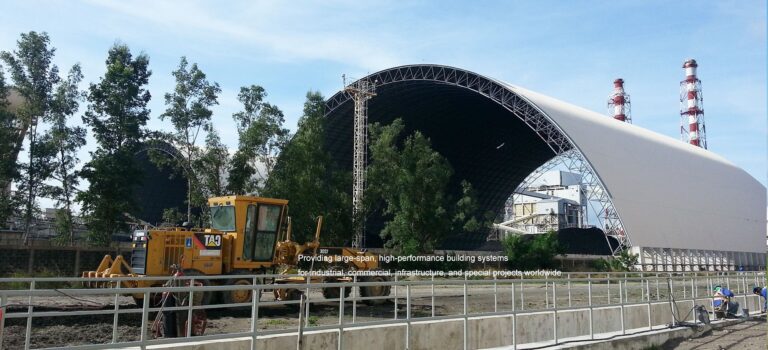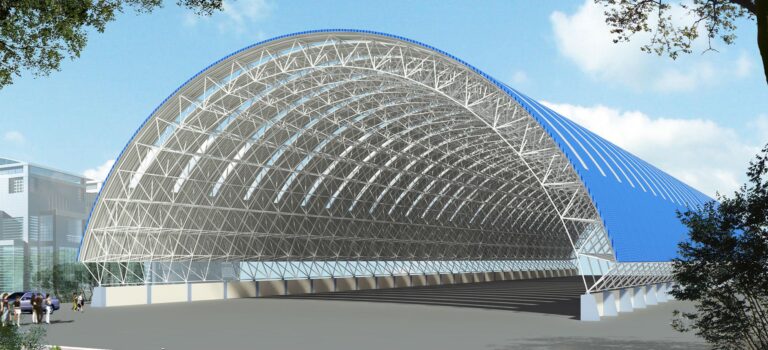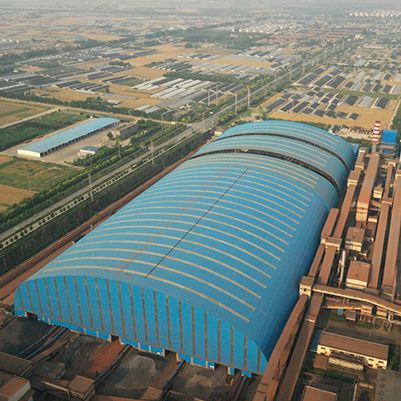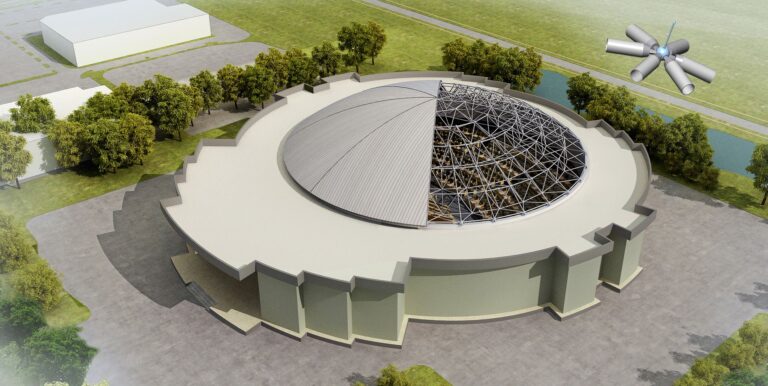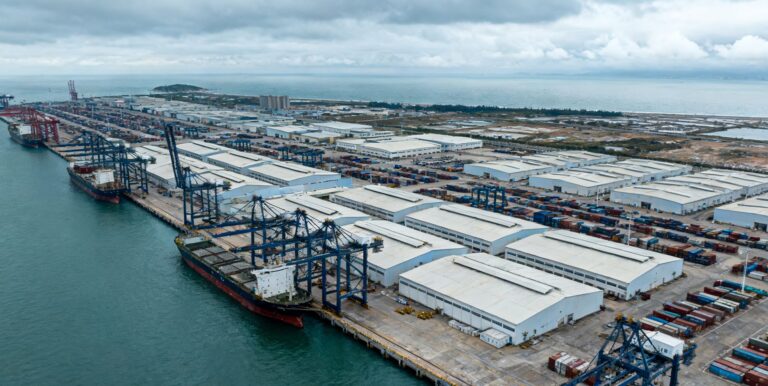


Enclosed coal storage silos ranging from 120 to 150 meters in span have become increasingly common in large ports and energy storage and transportation bases in recent years.
LF-BJMB has found that one of the most frequent questions from clients is: With such a large span, is the structure stable? Will it deform? Is it safe enough?
The conclusion is: Under modern spatial steel structure technology, a 150-meter span coal storage silo can achieve long-term stable operation, provided that every aspect of design, materials, joints, and construction is carried out according to specifications. It’s not that “bigger is necessarily more dangerous,” nor is it that “using a space frame guarantees safety.”

1.What Ensures the Safety of a 150-Meter Coal Storage Silo?
1.1 Detailed load calculations are essential.
Ultra-large span structures must undergo detailed modeling and calculations based on wind loads, snow loads, seismic intensity, and temperature stress at the project site, covering both extreme weather and conventional working conditions.
Load-bearing capacity, stiffness, and deflection must meet national standards; this is the bottom line in the design phase.
1.2 The structural system must be chosen correctly.
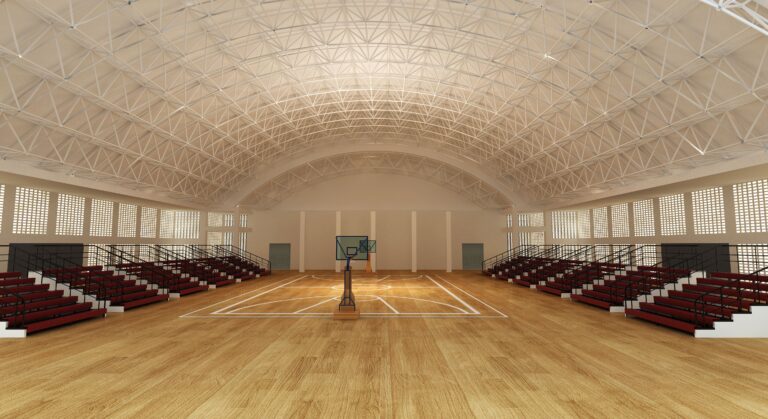
150-meter-class coal storage silos typically use bolted spherical steel structures, curved domes, or arched spatial structures. Loads are evenly distributed through multiple points, with overall coordinated stress distribution, avoiding the localized stress concentration problems of traditional planar structures.
However, this doesn’t mean any system will suffice—different systems have varying adaptability to span, roof loads, and construction conditions; choosing the wrong system can create hidden dangers.
1.3 Joints are crucial.
Supports, splicing joints, and welded joints are the load-bearing hubs of the entire structure. Ultra-large span projects must specifically strengthen the structural design of these areas to improve strength, toughness, and fatigue resistance. If the joints are faulty, even the strongest members cannot salvage the situation.
1.4 Materials cannot be skimped on.
High-strength steel is significantly superior to ordinary steel in terms of strength, toughness, and deformation resistance, making it a fundamental component of ultra-large span roofs.
Saving money on this aspect compromises subsequent design redundancy and safety reserves.
1.5 Construction requires control.
Factory prefabrication precision, on-site hoisting errors, and splicing quality—each step affects the stability of the final product. A robust quality acceptance system is essential to ensure controllable construction quality.
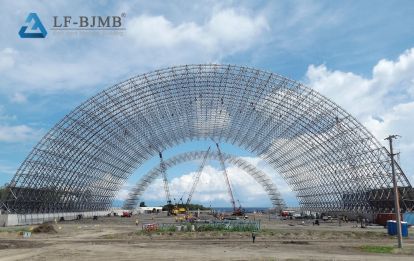
2.Performance in Actual Operation
Assuming both design and construction are in place, the deformation of a 150-meter-class coal storage silo is controllable, preventing abnormal deformation, swaying, or subsidence.
Spatial steel structures inherently possess a certain degree of toughness and deformation self-adaptation, capable of absorbing stress from wind, snow, and temperature changes. Furthermore, ultra-large span projects typically have higher design redundancy and greater safety reserves than conventional spans. This is why key projects like ports and large energy bases tend to use this approach—not because it’s “high-end,” but because it can withstand the requirements of long-term continuous operation.
3.Is a 150-Meter Coal Storage Silo Safe?
A 150-meter span is not a risky solution,it has mature technical support and practical application examples. However, maturity doesn’t equate to safety indiscriminately—load calculations, structural selection, joint construction, material grades, and construction control are all crucial. An error in any step can compromise safety.
For owners, instead of asking “Is a 150-meter span coal storage silo safe?”, it’s more important to ask “Have the design redundancy and construction control for this project been adequately implemented?”
4.Common Issues
4.1 Is a 150-meter super-large span coal storage silo prone to deformation?
With professional modeling and calculations, reasonable structural design, and standardized construction, abnormal deformation, shaking, or subsidence will not occur. Deformation is controllable, and operational stability is guaranteed.
4.2 Does it meet wind, snow, and earthquake resistance standards?
All super-large span projects undergo specialized calculations based on local extreme conditions, meeting wind, snow, and earthquake fortification standards. Safety reserves are typically higher than for conventional span projects, adapting to complex and harsh conditions.