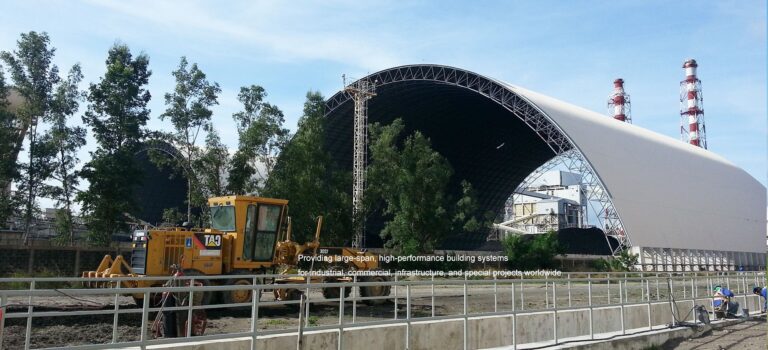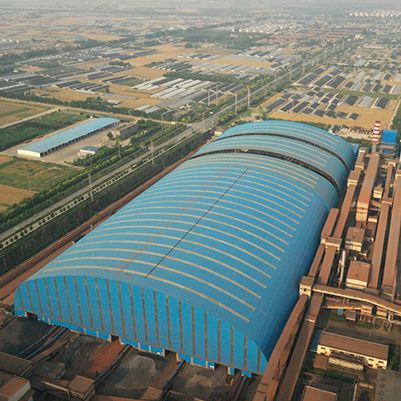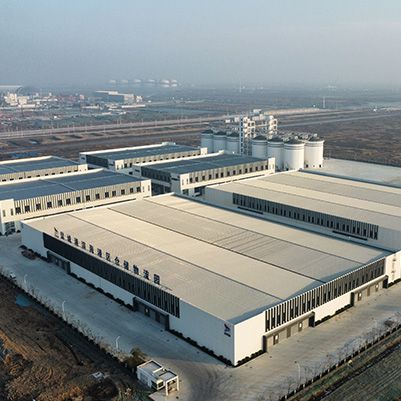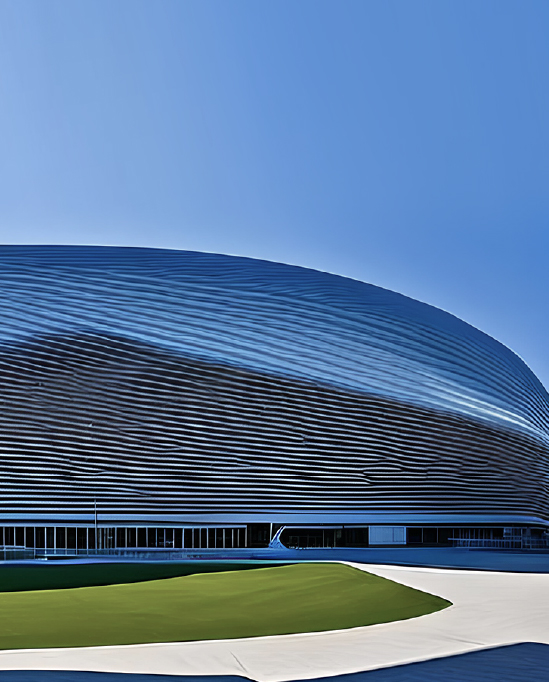


The technical challenges of sports venues primarily center on large-span roofs.
Unlike ordinary buildings, sports venues require large, column-free spaces and unobstructed views. They must also accommodate complex shapes while resisting wind and seismic forces. In addition, the roof needs proper drainage and long-term durability.
Currently, the three most widely used roof types both domestically and internationally are: bolted-ball structures, tubular truss structures, and cantilevered steel structures; landmark venues may also incorporate non-standard systems such as upper-chord trusses and cable-membrane structures.
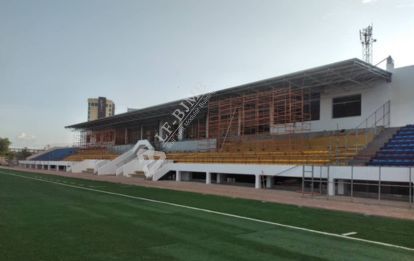
1. Bolted-Ball Structures
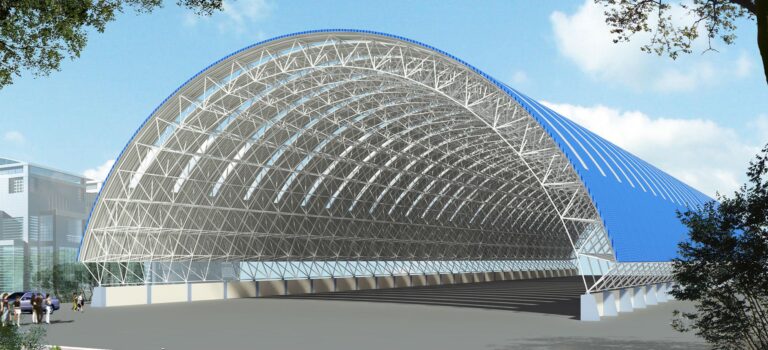
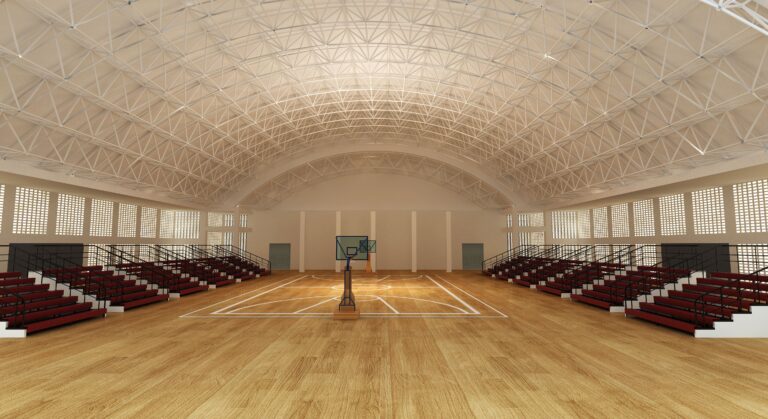
Bolted-ball structures are a common and well-established roof type for indoor venues. They consist of a three-dimensional grid formed by multidirectional steel tubes and bolted-sphere joints, resembling a three-dimensional honeycomb with excellent structural integrity.
Key Features:
Three-dimensional load-bearing coordination ensures even load distribution, high stiffness, minimal deformation, and excellent seismic performance;
Standardized components are prefabricated in factories and assembled on-site, resulting in fast construction and high stability.
Applications: Enclosed, long-span indoor venues, including multi-purpose sports arenas, training halls, swimming pools, public fitness centers, and multipurpose halls.
For projects that require a flat roof, high stiffness, suspended ceilings, or equipment suspension, space frames can be a suitable option. Common clear spans range from 60 to 100 meters.
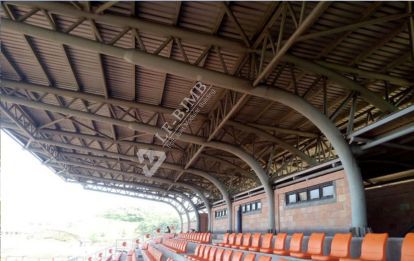
2. Tubular Truss Structures
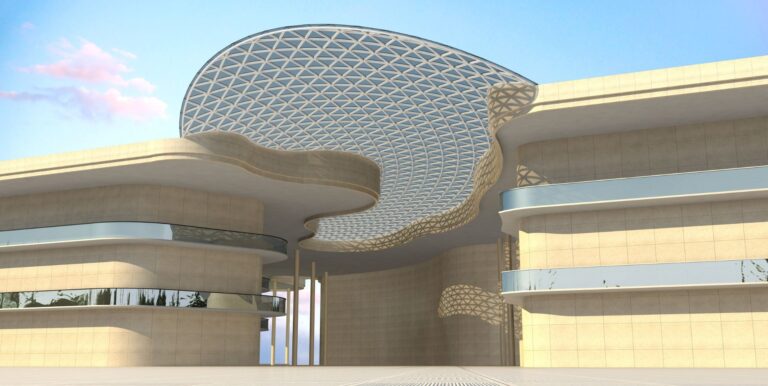
Tubular trusses are welded from round or square tubes to form planar or three-dimensional trusses, offering greater design flexibility. They are an ideal choice for balancing span requirements with architectural aesthetics.
Key Features:
Clean lines, high span capacity, and flexible design capabilities, capable of forming curved, arched, and irregular surfaces;
Light self-weight and high span capacity, suitable for roofs with large widths and extra-large spans.
Applications: Main roofs of large sports centers, integrated roofs of outdoor stadiums, and landmark venues requiring unique designs. Balancing performance and aesthetics, this is a popular choice for modern sports centers.
3. Cantilevered Steel Structures
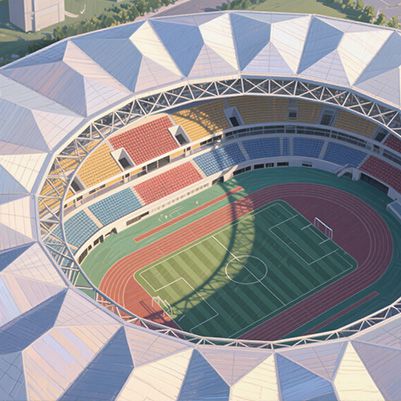
A cantilever is a unidirectional, long-span structural system without front columns, specifically designed to “cover spectator stands without obstructing the playing field.”
Key Features: No front supports; long clear cantilever spans (typically 40–60 m+); essentially avoids the playing field, providing zero obstruction to the view; concentrated load distribution, placing high demands on joints, steel quality, and wind resistance design.
Applications: Professional soccer stadiums, track and field stadiums, and outdoor grandstands. For projects requiring coverage of spectator seating without obstructing the playing field, cantilevered steel structures are the most commonly used solution.
4. Other Non-Standard Spatial Structures
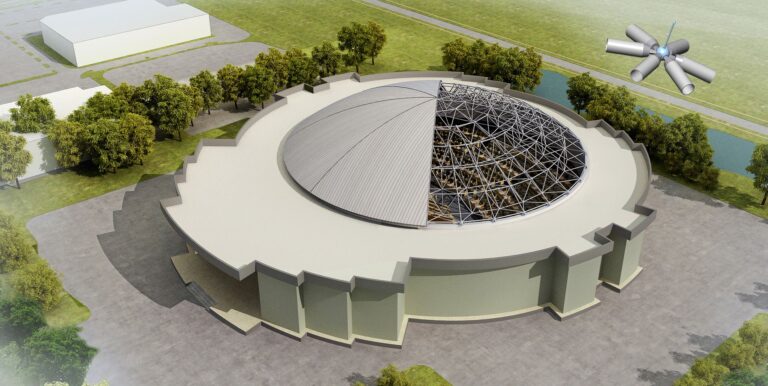
Landmark buildings with unique designs may also utilize cable-stayed beams, cable-membrane structures, and dome grids.
These structures can create distinctive architectural forms and achieve large spans. However, they generally involve higher design, fabrication, and construction costs. They are generally used for large-scale provincial or national landmarks and are not suitable for ordinary small-to-medium-sized projects.
5. Comparison of Structural Forms
| Structural System | Typical Applications | Key Features | Suitable Scenarios |
| Bolted-Ball Structure | Sports arenas, swimming pools, multi-purpose training centers | Three-dimensional load-bearing capacity, high rigidity, excellent flatness, and good stability | Enclosed, large-span indoor venues; projects with high requirements for roof precision and equipment suspension |
| Tubular Truss Structure | Large sports complexes, architecturally distinctive venues, multi-purpose stadiums | Flexible design, large spans, light self-weight, and attractive appearance | Venues requiring irregular roof shapes, wide-span roof structures, and a balance of aesthetics and functionality |
| Cantilevered Steel Structures | Soccer fields, track and field stadiums, outdoor grandstands | No front supports, zero obstruction of the view, extensive cantilevered coverage | Outdoor competition venue grandstands requiring rain and sun protection, where columns obstructing the competition area are strictly prohibited |
6. Which Structural Form Is Best?
There is no single “best” roof structure; only the one best suited to the specific project.
Indoor, enclosed spaces requiring a flat, stable roof with high cost-effectiveness and ease of equipment suspension → Consider bolted spherical node structures;
Landmark projects requiring irregular shapes and wide-span roofs → Consider tubular truss structures or bolted spherical node structures;
Outdoor grandstands for soccer fields, track and field stadiums, etc., requiring unobstructed viewing → Consider cantilevered steel structures.
Conclusion
Bolted-ball, tubular truss, and cantilevered structures are the three major systems that support modern venue roofs.
By selecting the right system early on based on venue type, span requirements, architectural design, and usage scenarios, you can achieve an optimal balance between safety, cost, aesthetics, and construction schedule.
FAQ Frequently Asked Questions
Q: Which roof system should be chosen for a small community gymnasium?
A: For small indoor facilities with limited spans, bolted-ball structures offer the best value—they provide a flat surface, good rigidity, ease of equipment hoisting, and convenient maintenance. There is no need to use tubular trusses or non-standard systems.
Q: Can cantilevered and bolted-ball structures be used together?
A: This is common. Many sports venues feature a combination of “cantilevered roof over the stands + space frame/truss roof over walkways and auxiliary buildings.” Selecting structures based on the function of each area does not create any conflicts.